WARDOGS Beginner Guide — Core Mechanics, Money and First Lives
Published 2026-09-11Updated 2026-09-197 min read
How WARDOGS actually works: factions, the control zone, the per-life economy, smart money makers and the mistakes that bankrupt new players.
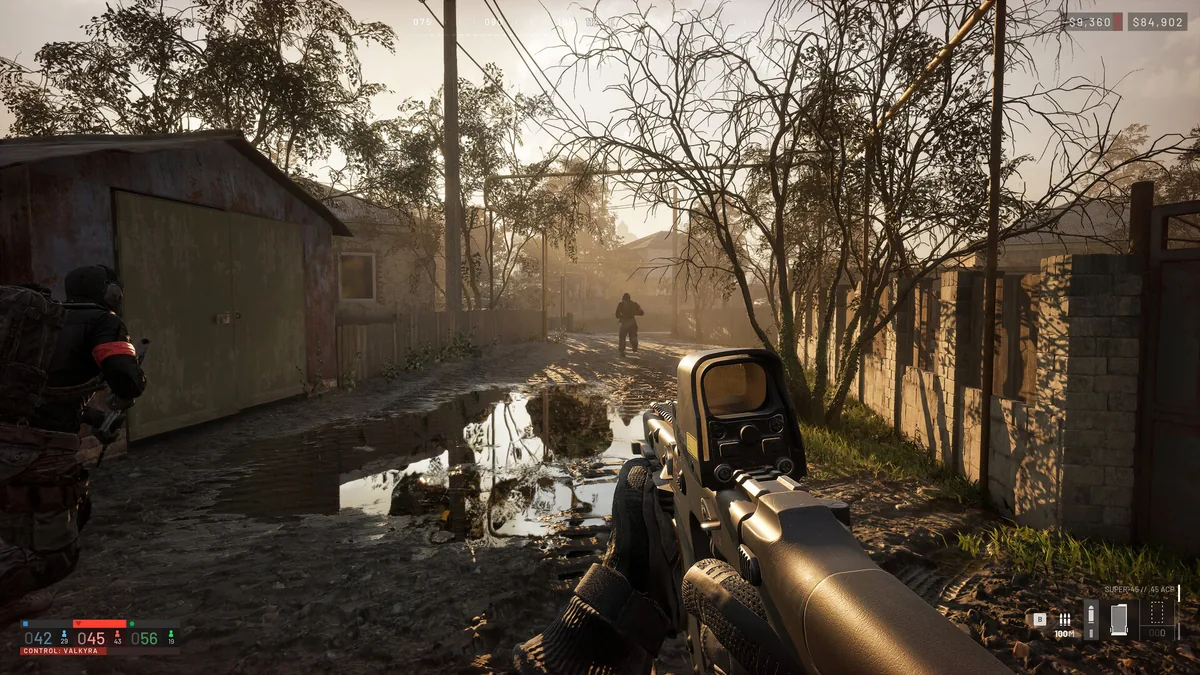
WARDOGS is a total-war-style FPS: up to 100 players in one massive military sandbox, where you earn money in-match to buy better gear. This guide covers the rules the tutorial rushes through and the habits that keep you rich.
Core Mechanics in 60 Seconds
- Three factions — red, green and blue — fight over one map, and you can switch sides mid-match.
- The map is 16×16 km, but the fight happens inside a randomly placed 2×2 km control zone with a hotzone that keeps moving inside it.
- Win condition: first team to 100 points. Every 30 seconds, the side with the most players inside the zone scores 1 point — and hotzone players count double.
- Real ballistics. Bullets have travel time and drop; long-range shooting needs zeroing (default 100 m, adjust with PageUp/PageDown, shown bottom-right).
- Economy: you start with $10,000, cash persists between matches, and every death wipes your kit. The top-right HUD shows your current life's profit and loss — dying in the green means the life was worth it.
Fast Money, Ranked by Risk
- Drive for a living. Taxi troops, haul cargo, fly transport. A delivered passenger pays $500–1,000, stays worth $500 for surviving about 15 seconds, then pays you $750 per kill they make. A full UH-1Y run nets up to ~$4,800.
- Haul supply pallets. A pallet costs $400 and pays $2,500 when delivered to the hotzone ($2,100 profit), plus $1,800 more if a teammate builds an FOB with it. Toss cargo with G. Small supply crates work the same — fill them with meds and ammo for the front.
- Play spotter. Binoculars are the cheapest item in the game. Scan from high ground at the hotzone edge: marks pay immediately, and every marked enemy a teammate kills pays you another $800. Want more? Add a range finder and a Mosin-Nagant (Recon level 1) with a 10x scope — kill rewards scale with distance.
- Medic loop. Revives pay $800 per teammate, bandages $400; a revive-plus-bandage set ($1,200) equals one hotzone kill. The $1,600 defibrillator pays for itself in three revives.
- Engineer grind. Buy the small hammer (free), whack sandbags and HESCO near a friendly FOB for $50 a swing. Heavy emplacements — CIWS, mortars, AA — inside a built FOB cost only construction supplies, not cash.
Weapon Sense Before You Spend
All 5.56mm rounds deal the same 28 damage whether the gun costs $600 or $2,800 — you are paying for accuracy, muzzle velocity, fire mode and attachment slots. The faction starter rifle is free but semi-auto only. The early value king is the T-21: full-auto, 750 rpm, 910 m/s, $600 — and vendor prices are half off below level 9, so it drops to $300. Mind ammo pricing: a cheap gun eating expensive rounds isn't cheap.
XP Is Your Loadout, Not Your Class
There are no locked classes. Experience follows the equipment you actually use: assault rifles and pistols feed Infantry; SMGs and medical gear feed Medic; shotguns, LMGs and launchers feed Support; marksman rifles, snipers and bows feed Recon. One loadout can train three tracks at once — sniper on your back, defibrillator in your pack, pistol on your hip.
Small Habits, Big Survival
- Carry loose ammo over magazines — more total rounds, refills mags with C, frees pack space.
- Parachute early. Opening too late breaks your legs on landing.
- Vehicles don't slow down off-road — cut through fields and forests.
- In helicopters: Shift accelerates, Ctrl (tapped) descends.
- HQ sits roughly 3 km from the control zone — walking is not a plan. Drive, or build an FOB.
Related: fast money guide · best starting classes · essential tips and tricks